As the Revolutionary War raged, it became clear that to win against Britain, the United States would need allies.
Among those allies were the Lenape, who entered into a treaty with the U.S in September,1778 at Fort Pitt, Pennsylvania. This treaty followed the successful February 1778 U.S. Treaty of Commerce and Alliance with France, making 1778 an important year for Revolutionary American diplomacy.
The Treaty of Fort Pitt marked the beginning of a long history of diplomatic relations between the Lenape and the United States. Together, they would enter into more than 40 treaties—the longest treaty series between the United States and any one tribe.
Join Joe Baker and Hadrien Coumans of the Lenape Center and Nicholas A. Robinson of the Pace University Elisabeth Haub School of Law to explore the 1778 Treaty of Fort Pitt and the enduring legacy of Lenape–U.S. relations.
Before and after the presentation, we invite you to view our Among the Powers of the Earth exhibit featuring a Turkey Feather Cape from the Lenape Nation.
Please RSVP by December 3, 2026. For further information or if you require reasonable accommodations to attend the event, please contact the us at nmad-programs@state.gov.
NMAD is located at 330 21st St NW, Washington, DC 20006, in the Harry S Truman Building. Please arrive between 9:45 am and 10:15 am to allow ample time for security processing. A government-issued REAL photo ID is required for entry (e.g. passport, U.S. driver’s license).
About the Speakers Joe Baker (Lenape, Delaware Tribe of Indians) is an artist, educator, curator, and Vietnam Era U.S. Air Force veteran. He served with the 308th Strategic Missile Wing, which oversaw Titan II intercontinental ballistic missiles. He has worked in Native arts for forty years. He is a descendant of Lenape leaders who took part in treaty diplomacy, including Captain Anderson Sarcoxie, Captain White Eyes, Netawatwees, and Tamanend. Baker is co-founder and executive director of the Lenape Center in Manhattan. For nearly twenty years, the Center has restored Lenape presence, history, and knowledge in New York City through the arts, culture, education, and institutional partnerships. It also brings Lenape peacemaking principles to institutional culture, public narrative, and policy. Under Baker’s direction, the Center has partnered with the Metropolitan Museum of Art and taken part in Cooper Hewitt’s Making Home. It co-published Lenapehoking: An Anthology with Brooklyn Public Library. Baker curated Lenapehoking, the first Lenape-curated exhibition of Lenape cultural arts in New York City, at Brooklyn Public Library. Baker holds a BFA and an MFA from the University of Tulsa. He completed postgraduate study at Harvard’s Graduate School of Education and is Visiting Professor of Museum Studies at Colorado College.
Hadrien Coumans is co-founder and Deputy Director of Lenape Center in New York and a traditionally adopted member of the Lenape WhiteTurkey–Fugate family. For 27 years, he has worked alongside Lenape elder Joe Baker, guided by a shared charge of cultural and institutional responsibility. For nearly twenty years, Lenape Center has restored Lenape presence, history, and knowledge in New York City through the arts, culture, education, and institutional partnerships. It also brings Lenape peacemaking principles to institutional culture, public narrative, and policy. Coumans holds United States Institute of Peace certifications in Conflict Analysis, Mediating Violent Conflict, and Land, Property & Conflict, and has trained in Trauma Awareness and Resilience. He has spoken at the United Nations, Brooklyn Law School, Pace School of Law, and Cardozo Law School’s Ferencz Human Rights & Atrocity Prevention Clinic. He has also addressed the governments of Australia, Finland, the Netherlands, and Canada. A writer and editor as well, he is co-editor of Lenapehoking: An Anthology, co-published by Lenape Center and Brooklyn Public Library. He has served as Associate Faculty at Columbia University’s Mailman School of Public Health. His writing includes “Wëlamàlsewakàn: Reimagining the Right to Health through Lenape Epistemologies” in Harvard’s Health and Human Rights Journal.
Nicholas A. Robinson is the Gilbert & Sarah Kerlin Distinguished Professor of Environmental Law Emeritus in the Elisabeth Haub School of Law at Pace University based in White Plains, New York. He has taught environmental law since 1978 at Haub Law School and lectured widely abroad on comparative and international environmental law, including the customary law of Indigenous Peoples. He chaired the Commission on Environmental Law of the International Union for the Conservation of Nature (IUCN). At the invitation of the Lenape Center, he led a research seminar at Haub Law School studying the treaties of the Lenape Nation, beginning with the treaty of Shackamaxon, negotiated by Tamanend for the Delaware and William Penn for the English (1682), through to US Continental Congress’ Treaty of 1778 with the Delaware and the treaties of the 19th century. His published scholarship includes the first history of the Forest Charter (carta de foresta) of 1217, and range of works on comparative and international law.
Image: 1781 French topographic map showing Fort Pitt’s strategic importance to the United States’ military advances during the Revolution and its advance into Native American territory after. Courtesy of George Washington’s Mount Vernon.
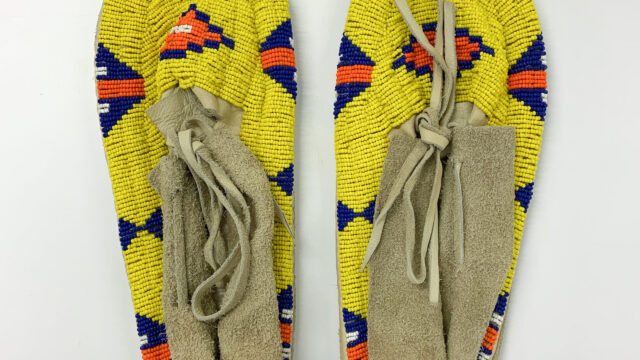
In 2014, Keith M. Harper became the first Native American to be named a U.S. ambassador to the UN Human Rights Council. A citizen of the Cherokee Nation, Harper served as the U.S. Permanent Representative to the UN Human Rights Council until 2017. These moccasins were a gift to him from his…
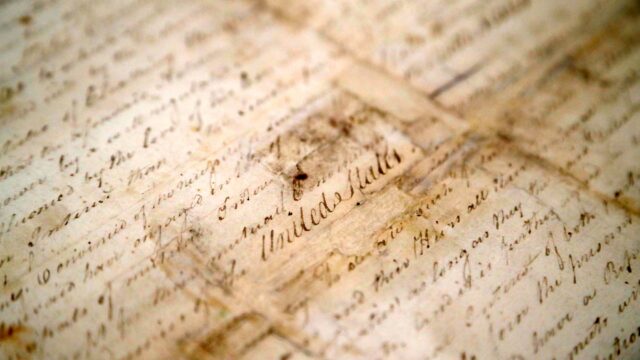
During the Revolutionary War, one of the United States’ earliest treaties was with the Lenape (Delaware) nation aimed at building an alliance against the British:…
Treaties and alliances are two ways the United States formalizes agreements with other countries and international organizations. Treaties are written agreements between nations or between…